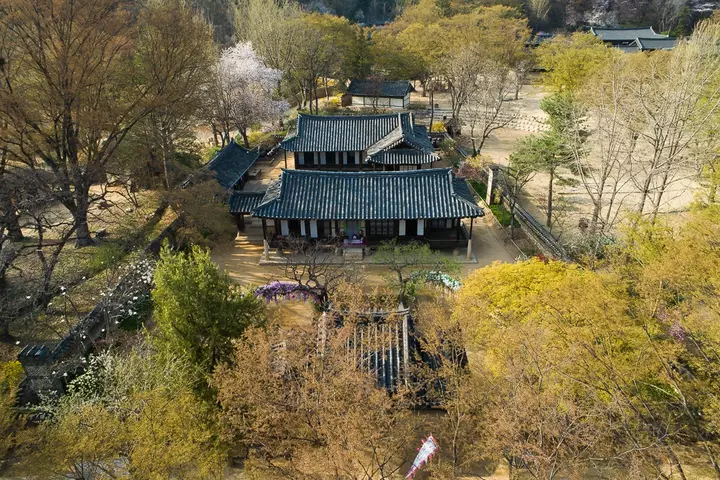
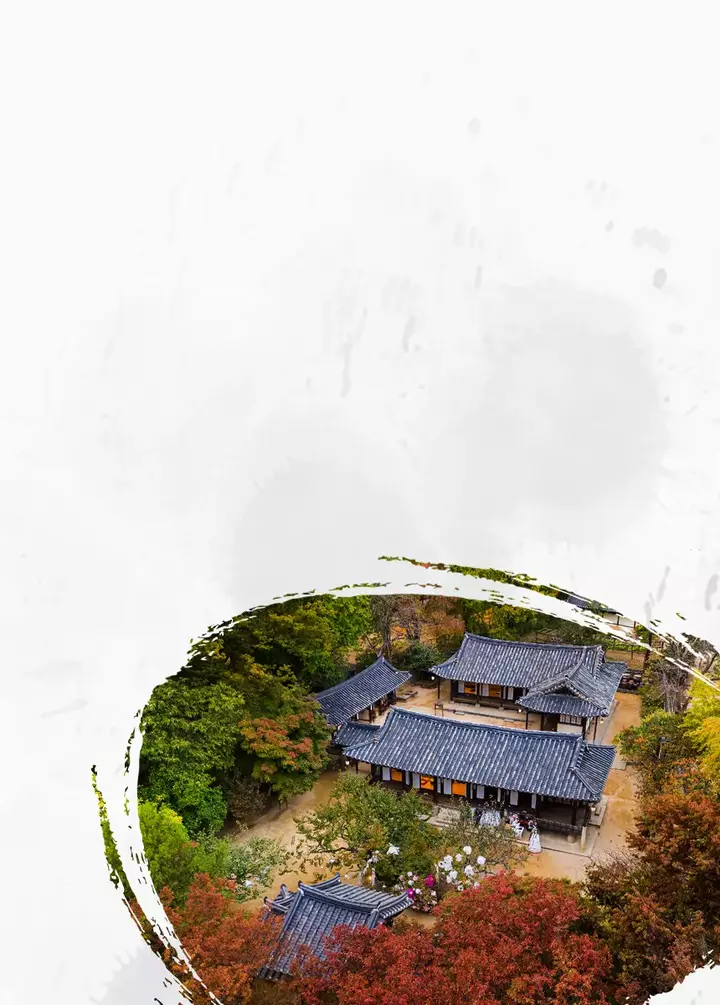
This is a large traditional house relocated from Hyeoncheon-ri, Sora-myeon, Yeocheon-gun, Jeollanam-do.
On either side of the tall main gate are servant quarters known as haengnangbang.
The inner courtyard is spacious, and the sarangchae also features a large yard with a flower garden—one of the unique features of this home.
The house is structured in a partially open square layout (similar to the Korean letter ㅁ),
with an L-shaped main building (anchae), a straight-lined men's quarters (sarangchae), and a storage wing (gwangchae).
Let’s begin with the sarangchae, shall we?
Across the wide wooden-floored hall (daecheong) is a small sarang room.
In front of it is a high-raised numaru (open wooden platform) with railings, and in front of the larger sarang room, there is also a wrapping numaru with railings.
The sarangchae was the domain of the male head of the household, used for welcoming guests, engaging in political discussions, or deep contemplation of scholarly and artistic matters—a social space, in essence.
Next, let’s take a look at the women’s quarters, the anchae.
The furniture and items in the anchae reflect a warm and gentle atmosphere, appropriate for the heart of family life.
Take a closer look at the legs of the cabinets and wardrobes (jang and nong).
They are quite tall, leaving a space between the furniture and the floor. This design helps prevent warping or damage from the heat of the ondol (traditional floor heating system), and also allows for better airflow.